Masseter Botox is an injection of botulinum toxin into the masseter, the thick chewing muscle that runs from the cheekbone to the angle of the jaw. Relaxing this muscle reduces the force behind clenching and grinding, eases the jaw pain and morning headaches that come with it, and, over a few weeks, softens a square or heavy-looking lower face. It is a quick outpatient treatment with no downtime, but it is not a cosmetic tweak to be done casually: the masseter sits next to the muscles that shape your smile and the duct of the parotid gland, so the result depends on who places the injections and where. This guide explains what the treatment does, whom it suits, how it is done, how long it lasts and what it costs in the UK compared with Antalya.
- What Is the Masseter Muscle and Why Does It Get Overworked?
- What Does Masseter Botox Actually Do?
- Who Is Masseter Botox For?
- How Is Masseter Botox Done?
- How Long Does Masseter Botox Take to Work and How Long Does It Last?
- What Are the Side Effects and Risks?
- Does Masseter Botox Cure Bruxism?
- What Does Masseter Botox Cost?
- Masseter Botox with Dr. Onur Ademhan
- Conclusion
What is the masseter muscle and why does it get overworked?
Put your fingers on the sides of your face, just in front of your ears, and clench your teeth. The muscle that bulges is the masseter. For its size, it is one of the strongest muscles in the body, and in most people it does its job quietly: it closes the jaw when you chew and rests the remainder of the time.
In some people it never quite rests. Daytime clenching at a desk, grinding at night (bruxism), chewing gum for hours, chewing on one side only, or simply a naturally powerful bite keep the muscle under load for far longer than it was designed for. Like any muscle that is worked constantly, it grows. This is masseter hypertrophy, and it shows up in two ways: a face that looks wider and squarer at the jaw angle, and a muscle that aches. Patients describe tightness in the cheeks, a jaw that feels tired on waking, headaches around the temples, clicking in the joint and teeth that are worn flat, chipped or sensitive. Dentists see the same story from the inside: cracked fillings, fractured crowns and porcelain veneers that keep breaking.
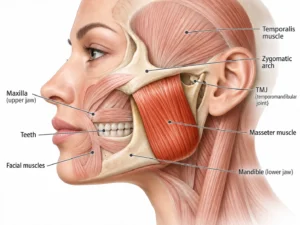
The masseter is one of the main chewing muscles and can become enlarged or painful when repeatedly overworked by clenching or grinding.
What does masseter Botox actually do?
Botulinum toxin type A blocks the signal between the nerve and the muscle fibres it supplies. The masseter does not stop working; it contracts with less force. Reducing masseter activity may decrease clenching force and muscle-related discomfort in selected patients. Clenching becomes weaker and less frequent, the constant tension eases, and pain originating in the muscle itself settles within one to two weeks. Because the muscle is no longer working at full strength, it gradually loses bulk over the following four to eight weeks, and the jawline narrows. The slimming is a side effect of the muscle relaxing, not a separate treatment, which is why patients who come for jaw pain often notice their face looks softer, and patients who come for a slimmer face usually sleep better. Chewing, speech, and facial expression are not affected when the treatment is dosed and placed correctly. The temporalis and medial pterygoid muscles continue to close the jaw, and only the excess activity of the masseter is removed.
Who is masseter Botox for?
Masseter Botox is worth considering if you have one or more of the following:
- Teeth grinding or jaw clenching with tenderness in the jaw muscles, tension headaches, or a jaw that aches in the morning
- TMJ pain that comes from the muscles rather than from the joint itself; a surgeon can tell the two apart on examination
- Masseter hypertrophy: a square or heavy lower face caused by enlarged chewing muscles, with or without pain
- New veneers, crowns or a full-arch implant bridge in a patient who clenches: reducing the bite force protects the porcelain and the implants
- Failed night guard therapy, or patients who cannot tolerate wearing a splint. It is not suitable in pregnancy or while breastfeeding, in people with neuromuscular conditions such as myasthenia gravis, where there is an active infection at the injection site, or where the jaw problem is structural (a displaced disc, arthritis of the joint) rather than muscular. In those cases, the joint needs assessing first; relaxing the muscle will not fix it.
How is masseter Botox done?
The appointment takes around twenty minutes and needs no anaesthetic.
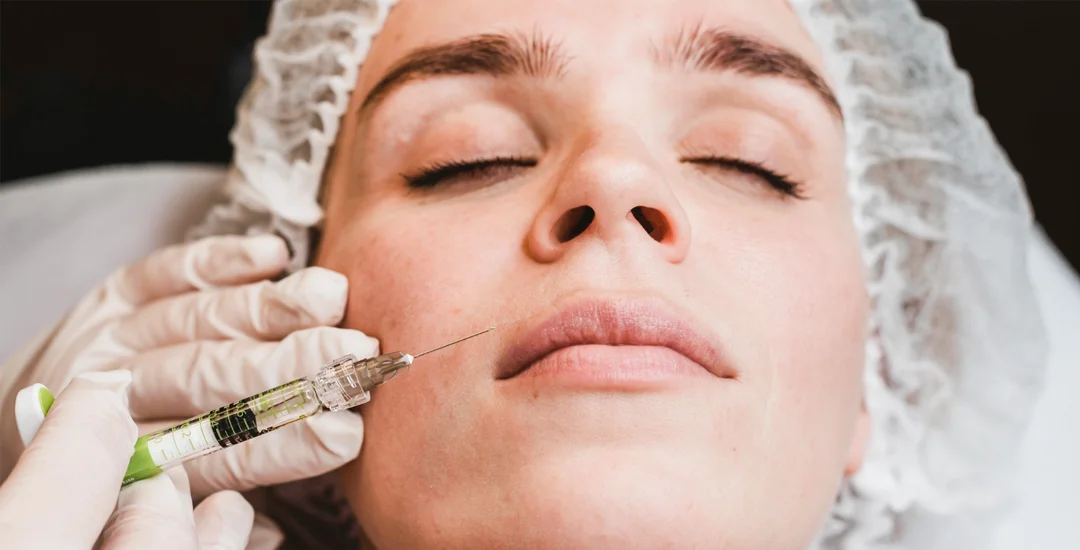
- Assessment: you clench while the surgeon feels the muscle and marks its borders. The safe injection zone is the lower, thicker part of the masseter, below an imaginary line from the earlobe to the corner of the mouth and behind the front edge of the muscle. Injecting above or in front of this zone risks reaching the muscles that lift the corner of the mouth, or the parotid duct.
- Dose: Dose is individualized according to muscle size, strength, symptoms, product used, and clinical assessment. Botulinum toxin units are also product-specific and should not be treated as interchangeable between formulations.
- Injection: two or three points per side with a very fine needle, deep into the body of the muscle. Most patients describe a brief sting and pressure, nothing more.
- Afterwards: you can go straight back to work. Avoid rubbing or massaging the area, lying flat, and strenuous exercise for the rest of the day, and go easy on very hard or chewy foods for the first few days.
How long does masseter Botox take to work, and how long does it last?
- Days 3 to 7: clenching feels weaker, and the muscle starts to relax. Pain relief usually begins here.
- Week 2: full muscle effect. This is when a review appointment is useful, and when a small top-up is given if one side is stronger than the other.
- Weeks 4 to 8: visible narrowing of the jawline as the muscle loses bulk.
- Months 3 to 4: the relaxing effect begins to wear off and clenching returns gradually.
- Months 4 to 6: the slimming lasts longer than the relaxation, because the muscle takes time to rebuild. Most patients repeat the treatment every four to six months. After two or three sessions, the muscle has usually shrunk enough that the intervals can stretch to six months or more, and the dose can often be reduced.
What are the side effects and risks of masseter Botox?
Common and temporary:
- A tired or weak feeling when chewing steak, nuts, or crusty bread, for two to three weeks • Small bruises or tenderness at the injection points
- A mild headache for a day or two. Uncommon, and almost always related to dose or placement
- An uneven or lopsided smile if the toxin spreads forward into the risorius or zygomaticus muscles. This wears off with the treatment but can take weeks
- Hollowing under the cheekbones in patients with thin faces and little fat, when too much muscle volume is removed. In this group, a lower dose is used
- Loose skin along the jawline in older patients treated repeatedly with high doses, because the skin was resting on the muscle. Again, dose and interval matter
- Dry mouth or swelling near the ear if the parotid gland is involved, which is rare with correct technique. None of these are reasons to avoid the treatment, but all of them are reasons to have it done by someone who works on jaw anatomy daily rather than in a general aesthetics setting
Does masseter Botox cure bruxism?
No, and any clinic that says it does should be treated with caution. Grinding is driven by the nervous system, often by stress and disrupted sleep, and the toxin does not change that. What it changes is the force the muscle can produce, which is what causes the damage. Clenching still happens; it happens at a fraction of the strength. For most patients, that is enough to remove the pain and stop the tooth wear. For patients with expensive dental work, a night guard is still recommended alongside the injections, because a well-made splint protects porcelain and implant bridges in a way that a partially relaxed muscle cannot guarantee. Addressing sleep, caffeine, and stress remains part of the plan.
How much does masseter Botox Cost in the UK and Antalya?
In the UK, masseter Botox is a private treatment for almost everyone. NHS funding for botulinum toxin in the jaw muscles is limited to cases where conservative treatment such as splints, physiotherapy and medication has failed over several months, and even then it is not routinely approved. Private clinics commonly charge between £350 and £450 for both sides, depending on the units used and who is injecting. Only a doctor, dentist or nurse prescriber can prescribe the toxin in the UK, so it is worth checking that the person assessing you is one of them and that they understand the jaw rather than only the forehead.
In Antalya, the same treatment costs roughly £200 to £300 per session with the same products. Nobody should fly to Turkey for a masseter Botox session alone; the maths does not work once you add flights and the fact that it needs repeating. Where it makes sense is as part of a dental trip. Patients coming to Antalya for smile design, Dental implants, or a full-arch bridge can have the masseter treated during the same visit, often on the day the final restorations are fitted, and continue maintenance sessions with a UK prescriber or on a later visit.
Prices checked: October 2026
Masseter Botox with Dr. Onur Ademhan in Antalya
Dr. Onur Ademhan is an oral and maxillofacial surgeon whose daily work is jaw implants, corrective jaw surgery, TMJ treatment, and full-arch rehabilitation. Masseter Botox at his clinic is planned from that perspective. Every patient is examined for the source of the pain first, so that a joint problem is not treated as a muscle problem, and clenchers who are having veneers or implant bridges placed are offered the treatment as protection for the new work, not as an add-on sold at the desk. The clinic is in the Lara district of Antalya, ten minutes from the airport, with English-speaking staff and a dedicated English line for international patients.
Conclusion
Masseter Botox is a simple, well-tolerated treatment that does two things at once; it takes the force out of clenching and grinding, and it slims a jaw that has grown heavy from years of overwork. It does not cure bruxism; it wears off in a few months, and it must be placed carefully to avoid touching the muscles of the smile. In the right hands, it relieves pain, protects teeth and dental work, and reshapes the lower face without surgery. The starting point is an examination that confirms the problem is muscular, followed by a dose that fits your anatomy.
Does masseter Botox stop teeth grinding?
It reduces the strength of clenching and grinding rather than stopping the habit. For most patients, that is enough to end the pain and tooth wear. A night guard is still advised if you have veneers, crowns, or implant bridges to protect.
How many units of Botox are used in the masseter?
Usually 20 to 30 units per side for pain and clenching, and 40 to 50 units per side for pronounced muscle enlargement. The amount is decided by feeling the muscle while you clench, not by a fixed formula.
Will masseter Botox change my smile or the way I chew?
Not when it is placed correctly in the lower part of the muscle. Very hard foods may feel like more effort for two to three weeks. An uneven smile is a sign the toxin reached the wrong muscle and is avoided by staying within the safe injection zone.
How long does masseter Botox last?
Pain relief and reduced clenching last around three to four months. The slimming effect lasts four to six months, and after several sessions, the intervals usually become longer.
Is it safe to have masseter Botox from a dentist or oral surgeon?
Yes, and for this muscle, it is often the better choice. Dentists and oral and maxillofacial surgeons work with the jaw muscles and the temporomandibular joint every day and can tell whether your pain is muscular or joint-related before injecting anything.
Can I have masseter Botox on the same trip as veneers or implants?
Yes. It is commonly done on the day the final restorations are fitted, so the new porcelain or bridge is protected from full-strength clenching from the start. It takes about twenty minutes and does not affect the dental work.
How Much does Masseter Botox cost in Antalya compared with the UK?
Roughly £200 to £300 per session in Antalya against £350 to £450 privately in the UK. It only makes financial sense abroad as part of a dental trip, since the treatment needs repeating every four to six months.
Is masseter Botox the same as TMJ treatment?
No. Masseter Botox targets excessive activity in the chewing muscles. TMJ disorders can involve the joint, muscles, or both, so treatment depends on the underlying cause. A clinical assessment helps determine whether the symptoms are primarily muscular or joint-related.