If you are reading about dental implants, you will soon see clinics mention “guided implant surgery”, “computer-guided implants” or “keyhole implants”. It sounds like a different kind of implant. It is not. The implant itself, the titanium post and the tooth on top of it, can be the same. What changes is how the surgeon decides where the implant goes and how that decision is carried into your mouth on the day.
In this guide, we explain what guided implant surgery is, how it differs from freehand placement, what the accuracy studies actually show, when a surgical guide is genuinely worth it and when it is not, and what to ask your clinic before you book.
- What Is Guided Implant Surgery?
- How Is a Freehand Implant Placed?
- What Is the Difference Between Guided and Freehand Implants?
- How Does Guided Implant Surgery Work, Step by Step?
- Is Guided Implant Surgery More Accurate?
- Does a Guided Implant Last Longer?
- When Is Guided Implant Surgery Most Useful?
- When Is a Surgical Guide Not the Right Tool?
- Is Guided Implant Surgery Less Painful?
- Guided Implant Surgery with Dr. Onur Ademhan in Antalya
- Conclusion
What is guided implant surgery?
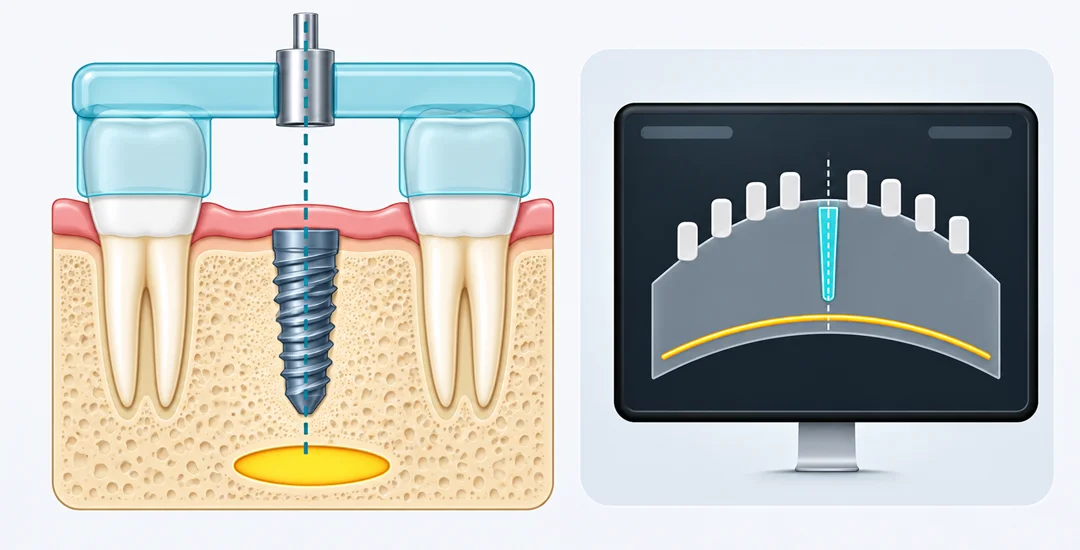
Guided implant surgery is a way of placing a dental implant according to a plan made on a computer beforehand. A 3D scan of your jaw shows the height and width of the bone, the position of the nerve in the lower jaw, and the sinus in the upper jaw. The surgeon places a virtual implant on that scan, checks it from every angle, and moves it until it sits in good bone, clear of the nerve and in the right spot under the tooth that will eventually go on top.
That plan is then turned into a surgical guide: a thin, rigid splint, usually 3D printed, that fits over your teeth or gums. It has a small metal sleeve exactly where the implant should go. During surgery, the drills pass through that sleeve, so the hole in the bone follows the planned angle and depth rather than an estimate.
There are three main forms of guidance:
Static guides: the printed splint described above. This is what most clinics mean by guided surgery.
Dynamic navigation: a camera tracks the drill in real time against the plan on a screen, with no splint in the mouth.
Robotic assistance: a robotic arm holds the drill on the planned path. It is still rare outside a small number of centres.
How is a freehand implant placed?
In freehand placement, the surgeon still studies an X-ray or 3D scan before surgery, but there is no physical guide. On the day of surgery, the gum is usually opened so the bone can be seen directly, and the surgeon judges the position, angle, and depth by eye, by feel, and with small measuring tools, checking as the drilling progresses.
Freehand does not mean careless. Experienced surgeons have placed implants this way successfully for decades, and in a straightforward site with plenty of bone, the result can be excellent. The difference is that accuracy depends more on the surgeon’s judgement in the moment, and the final position can drift slightly from what was intended, especially in angle.
What is the difference between guided and freehand implants?
The implant is the same. The difference is in planning, in how the plan reaches the bone, and often in how much the gum needs to be opened.
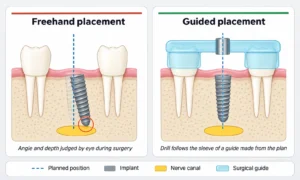
In freehand placement, angle and depth are judged during surgery. With a guide, the drill follows a sleeve built from the digital plan
| Comparison | Freehand Placement | Guided Placement |
|---|---|---|
| Planning | X-ray or CBCT reviewed, with the final implant position decided during surgery | CBCT and digital impression combined, with the implant position planned on screen before surgery |
| On the Day | The gum is often opened to provide direct visibility of the bone during placement | Drilling follows a surgical guide sleeve, sometimes through a small opening in the gum |
| Accuracy | Implant positioning depends more on the surgeon's clinical judgement during the procedure | Implant placement follows the digital plan more closely when the surgical guide is accurately fitted |
| Stitches and Swelling | Stitches and swelling may be greater when a gum flap is raised. | Stitches and swelling may be reduced when a flapless approach is suitable |
| Preparation Time | Usually shorter because a custom surgical guide is not required | Usually longer because digital planning and surgical guide fabrication are completed beforehand |
| Cost | Usually lower, without the additional surgical guide preparation | Usually higher due to digital planning, guide design and fabrication |
In short:
- Guided surgery moves the important decisions from the operating chair to the planning
- It is most valuable when there is little room for error: thin bone, a nerve or sinus close by, several implants in a row, or a fixed bridge that must line up.
- It does not replace the surgeon. A guide is only as good as the scan, the plan, and the person using it.
How does guided implant surgery work, step by step?
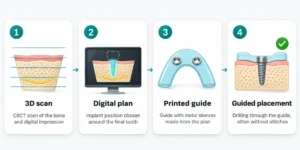
Guided implant surgery runs from a 3D scan to a digital plan, a printed guide and finally placement through the guide
- 3D scan and digital impression: a CBCT scan shows the bone and nerve. An intraoral scan (or an impression) records your teeth and gums. The two are merged into one 3D model.
- Planning around the final tooth: the future crown or bridge is designed first, and the implant is placed under. This is called prosthetically driven planning, and it is one of the main advantages of the guided approach: the screw-hole and the tooth end up where they should be, not wherever the bone happened to allow.
- Making the guide: the guide is printed from the plan and fitted with metal. Before surgery, it is tried in to check that it sits firmly and does not rock.
- Guided placement: under local anaesthetic, the guide is seated, and the drills pass through the sleeves. In many cases the implant goes in through a small round opening in the gum, without a full flap or stitches.
- Temporary and final teeth: depending on the case, a temporary tooth or bridge may be fitted the same day or within a few. The final crown or bridge follows once the implant has bonded with the bone, usually after three to six months.
Is guided implant surgery more accurate?
Yes, on average. Accuracy is measured as the difference between where the implant was planned and where it actually ended up, at the top of the implant, at its tip, and in its angle. In a 2025 systematic review and meta-analysis of implants placed straight after extraction, static guides placed the top of the implant within about 0.8 mm of the plan and the tip within about 1.1 mm, with an average angle difference of around 2 degrees. Across the studies that compared guided and freehand placement directly, computer-guided placement reduced the deviation at the top and tip of the implant by roughly 0.7 to 0.9 mm.
A millimetre sounds small, and in a wide, healthy jaw it often makes no practical difference. It matters when the margin is small: when the bone is only just wide enough, when the nerve sits a few millimetres below the planned tip, when an implant must sit between two natural roots, or when four or six implants must line up to carry one fixed full-arch bridge.
Two cautions belong here: First, these are averages, and a guide that does not sit perfectly can carry its own error into the bone. Second, guided accuracy depends on the quality of the scan and the plan. A poor plan placed accurately is still a poor plan.
Does a guided implant last longer?
Not necessarily, and it is worth being clear about this. Studies comparing failure rates of guided and non-guided implants have not shown a consistent difference in how many implants survive. When both are done well, freehand and guided implants have similar long-term survival.
Where guided surgery helps is in the things that affect comfort and the final result rather than survival alone: a better position under the crown, fewer surprises during surgery, less invasive access in suitable cases, and a more predictable timeline. For patients travelling from the UK, that predictability has real value, because the treatment plan and the number of days needed can be fixed before you book your flights.
When is guided implant surgery most useful?
A surgical guide is usually most worthwhile when:
- The bone is thin or limited, and there is little room to adjust the angle. This often overlaps with patients asking whether they can have implants without bone grafting.
- A nerve or sinus is close, such as in the lower back jaw or under the upper sinus
- Several implants are placed together, especially for a full-arch bridge such as All-on-4, where the implants must be parallel enough for one bridge to fit.
- The tooth is in the smile zone, where a small error in angle can show as a visible screw-hole or an unnatural gum line.
- A same-day temporary tooth or bridge is planned, because the temporary can be prepared in advance from the same plan.
- A less invasive approach is preferred, for example in patients who want to keep swelling and stitches to a minimum.
When is a surgical guide not the right tool?
Guided surgery is not automatically better in every case. A guide may not be the best choice when:
- Mouth opening is limited, because the guide and longer drills need extra space, which can make work on the back molars difficult.
- The site needs bone grafting or sinus work at the same time, where the surgeon needs open access, and the plan may change once the bone is seen.
- The extraction site is unpredictable, for example after a difficult extraction where the socket shape differs from the scan.
- The case is simple, with plenty of bone and no nearby structures, where an experienced surgeon working from a 3D scan will achieve the same result.
- Very advanced bone loss calls for a different approach altogether, such as zygomatic implants, which follow their own planning and surgical protocol.
The better question to ask a clinic is not “Do you use guides?” but “Why is, or isn’t, a guide the right choice for my case?”
Is guided implant surgery less painful?
Guided surgery is carried out under local anaesthetic, like freehand placement, so you should not feel pain during the procedure. Where it often makes a difference is afterwards. When the implant can be placed through a small opening in the gum instead of a full flap, there are usually fewer or no stitches, less swelling, less bruising and an easier first few days.
That flapless approach is not possible in every case, as it needs enough attached gum and a clear view of the bone on the scan. Recovery advice is otherwise similar to other minor oral surgery: soft food for the first few days, careful cleaning around the site, and no smoking. Our guide to healing after tooth extraction covers the same principles.
Guided Implant Surgery with Dr. Onur Ademhan in Antalya
Dr. Onur Ademhan is an oral and maxillofacial surgeon and the founder of Perla Dental Clinics in Antalya. Every implant case at the clinic starts with a CBCT scan and a digital assessment of the bone, the nerve, and the sinus, so the decision between guided and freehand placement is made for each implant rather than as a fixed policy.
For single implants in the smile zone, multiple implants and full-arch bridges, the plan is built around the final teeth, and a surgical guide is used where it improves precision or allows a less invasive approach. For UK patients, the plan, the number of visits, and the expected timeline are set out before travel, and completed cases can be seen in our smile gallery.
Conclusion
Guided implant surgery is not a different implant. It is a different way of getting the same implant into the right place. By planning on a 3D scan and carrying that plan into the mouth with a printed guide, the surgeon can place implants more accurately and, in many cases, less invasively.
It is most valuable when the margin for error is small, and less important in simple cases with plenty of bone. The best outcome comes from a careful scan, a plan built around your final teeth, and a surgeon who can explain why a guide is or is not right for you.
Is a guided implant a different type of implant?
No. The implant and the crown can be identical. “Guided” describes how the implant is planned and placed, using a 3D scan and a surgical guide, not the implant itself.
Is guided implant surgery better than freehand?
It is more accurate on average and often less invasive, but it is not automatically better for every case. In simple sites with plenty of bone, an experienced surgeon can achieve the same result freehand. Guides add most value where bone is limited, nerves or sinuses are close, or several implants must line up.
Do guided implants last longer?
Studies have not shown a consistent difference in survival between guided and freehand implants when both are done well. The benefits are mainly better positioning, more predictable surgery, and, in suitable cases, easier recovery.
Is guided implant surgery the same as keyhole or flapless surgery?
Not quite. Flapless or “keyhole” surgery means placing the implant through a small opening in the gum without raising a flap. A guide often makes that possible, but guided surgery can also be done with a flap, and flapless surgery can be done without a guide.
How long does guided implant surgery take?
Placing a single implant through a guide usually takes less than an hour. The planning and printing of the guide happen beforehand, typically within a few days of the scan.
Does guided implant surgery cost more?
Usually, yes, because it adds the digital planning and the printed guide. The extra cost is generally small compared with the total treatment, and many clinics include it for complex or multiple-implant cases.
Can I have guided implants if I need bone grafting?
Sometimes. Minor grafting can be combined with guided placement, but larger grafts or sinus lifts often need open access, so the surgeon may choose a partly guided or freehand approach for that site.